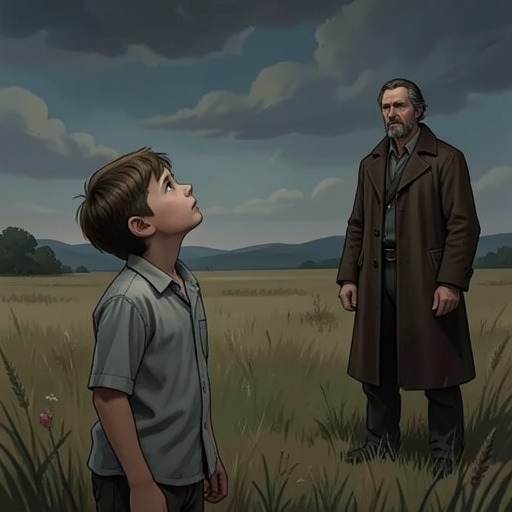
Dasa’s killing of Nala and flight
The Glass Bead GameDasa’s killing of Nala and flight is the decisive reversal in the story of Dasa’s imagined life: after learning that Pravati has gone to Prince Nala, Dasa kills him with the sling he once used as a herdsman and escapes into the wilderness. The act avenges the loss of his marriage but makes him a hunted fugitive, separating him from the life he had built and beginning a long passage through grief, danger, and self-reckoning.
Background and betrayal
Dasa’s happiness with Pravati had lasted less than a year. When Nala, the young Rajah, arrived in the neighborhood with troops, horses, and a supply train to hunt, Dasa continued working in the fields and at the mill, keeping away from the court. He had forbidden Pravati to go outside while the court was nearby. Returning to his hut one day, he found her missing, and a growing foreboding sent him searching between their home and her father’s house, through the fields and cabbage patch, and even down into a well. No one would tell him where she was.
The truth came from Pravati’s youngest brother, still a boy: Pravati was living in Nala’s tent. Dasa then watched the encampment from hiding, carrying the sling from his herdsman days. When he saw Nala return from riding and Pravati come forward to welcome him, he could no longer doubt what had happened. The discovery turned the attachment on which Dasa had invested his hopes into a sense of loss and insult. The betrayal is therefore not merely the setting for revenge: it is the collapse of the happiness he had taken as the center of his life.
The killing and escape
Dasa stayed near the camp, approaching whenever Nala’s tent seemed unguarded and retreating when guards appeared. From a tree he watched Nala ride away and later return. Once he recognized Pravati inside the tent, he waited for the moment Nala would come out. He had circled between his hut, the mill, the fields, and the hunting camp, exhausted but unable to leave the scene of his loss; at last he used the sling to strike Nala with a stone.
After Nala fell, a brief silence interrupted Dasa’s rush of vengeance. Before servants filled the space outside the tent, Dasa had fled into the bamboo thickets. In the instant of the attack, he had felt as if he were casting away his own life along with the stone, ready to die if Nala died first. But once the deed was done, an instinct for survival carried him away. When he reached shelter, the frenzy ebbed into exhaustion and revulsion at having escaped; as his strength returned, that revulsion gave way to a defiant determination to live, accompanied by renewed pride in the deed. The killing thus leaves him divided: he has acted as though his own life no longer matters, yet immediately begins the struggle to preserve it.
Pursuit and fugitive life
The search for the killer spread through the woods. Dasa evaded the searchers by remaining motionless in a marshy hiding place that they feared to enter because of tigers. He rested, crawled onward, and by the third day had passed beyond the hills, continuing toward the higher mountains. His flight was not a single escape from the camp but the beginning of a homeless existence.
That life made Dasa harder and more callous, but also wiser and more resigned. He repeatedly dreamed of Pravati and the happiness he had known, as well as of pursuit and escape. In one recurring nightmare, he fled through woods and swamps with hunters behind him, carrying a precious, concealed burden wrapped in cloth patterned like Pravati’s holiday dress. At the end of the flight he unwrapped the bundle and found his own head. The dream gives the fugitive’s past a disturbing shape: what he cannot release is bound to the lost relationship and to the life he himself has put at risk. Even when he is no longer actively fleeing pursuers, he continues to avoid people, living under the pressure of the act and its consequences.
Meaning in the tale
The episode makes revenge the hinge between Dasa’s former life and his later homelessness. Before Pravati’s disappearance, love had seemed to restore and complete his world; after he sees her with Nala, that world contracts into the pursuit of the man he regards as his enemy. The return of the sling from Dasa’s herdsman past links the violence to an earlier identity, while his flight into the bamboo thickets reverses the settled life he had briefly made with Pravati.
The killing also belongs to the fictional “Life” form in which Dasa’s story appears. These exercises let students imagine themselves living in another period and culture, treating their present selves as temporary identities through which a life might be viewed. Dasa’s story gives that experiment a concrete arc: happiness, betrayal, revenge, and flight become experiences a student can imaginatively inhabit without turning them into a claim of literal reincarnation. The later reflection that Dasa’s life and its joys and sorrows are Maya—illusion—does not erase the force of his attachment or the consequences of the killing. Rather, the tale places the violence and grief inside a larger inquiry into how intensely lived experiences can command a person even when they may be understood as transitory.